Communication Time Machine
Send one message through Ancient, Middle and Modern communication systems.
Interactive digital museum · Sri Lanka
Travel through three communication eras and experience how signals became records, mass media and intelligent networks.


Exhibition attractions
Send one message through Ancient, Middle and Modern communication systems.
Answer three era questions before the clock reaches zero.
01 · ANCIENT COMMUNICATION
Before electronic media, communication depended on human senses and physical materials. Voice, gesture and visible signals could carry urgent meaning, while marks, inscriptions and manuscripts allowed information to remain after the original speaker was gone.
Rock and cave imagery demonstrates the power of visual marks as durable cultural traces. Later written traditions moved information onto prepared surfaces, making knowledge easier to preserve, organize and pass between generations.


FROM ROCK TO MANUSCRIPT
Palm-leaf manuscripts transformed natural material into a compact writing system. Prepared leaves could be inscribed, arranged in sequence and bound together. Sri Lankan examples survive in museum and library collections, preserving religious, literary, medical and other forms of knowledge.


02 · MASS COMMUNICATION
Printing changed the economics of communication: instead of producing one manuscript at a time, mechanical systems could reproduce the same page for many readers. Newspapers, official publications, books and educational material could circulate repeatedly.
Electrical communication changed the relationship between distance and delay. Telegraph systems encoded text as electrical signals, telephones carried voice through circuits, and radio made it possible for one live transmission to reach a large audience.
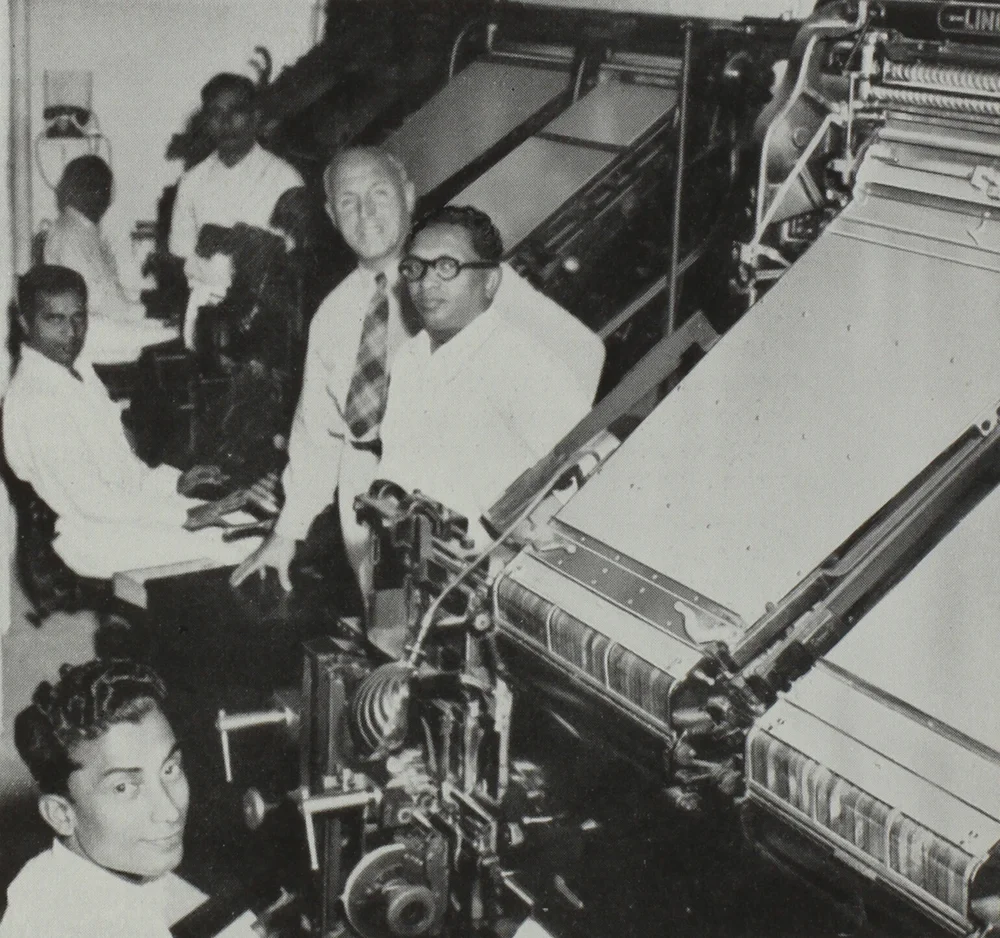

THE SCALE REVOLUTION
Print and broadcast solved different parts of the same problem. Printing created many durable physical copies; radio created a shared live signal. Together they helped establish communication systems capable of addressing publics rather than only individuals.
Typesetting assembles text into a reproducible form. Ink and mechanical pressure then transfer that form onto paper.
Telegraphy represents characters as coded pulses, allowing information to travel electrically rather than waiting for the physical document to arrive.
Radio converts programme audio into a transmitted electromagnetic signal that many receivers can tune into.
03 · NETWORKED COMMUNICATION
Modern communication converts text, voice, images and video into digital data. Mobile and internet networks can move that data between people, devices and services at near-instant speed, while cloud platforms keep information available across multiple devices.
The major shift is convergence: tools that once required separate media now operate through shared digital infrastructure. AI adds another layer by helping systems generate, translate, summarize, search and reorganize information.


THE NETWORK LAYER
A digital message can be copied without changing the original, routed through many networks, stored in multiple locations and presented as text, sound, image or video. The same infrastructure can support private conversations, mass publishing and many-to-many communities.
The phone becomes camera, microphone, editor, archive, receiver and transmitter in a single interface.
Information is divided into digital data and routed through wired and wireless infrastructure toward its destination.
Connected services synchronize information, while intelligent software can search, transform, translate and generate content.